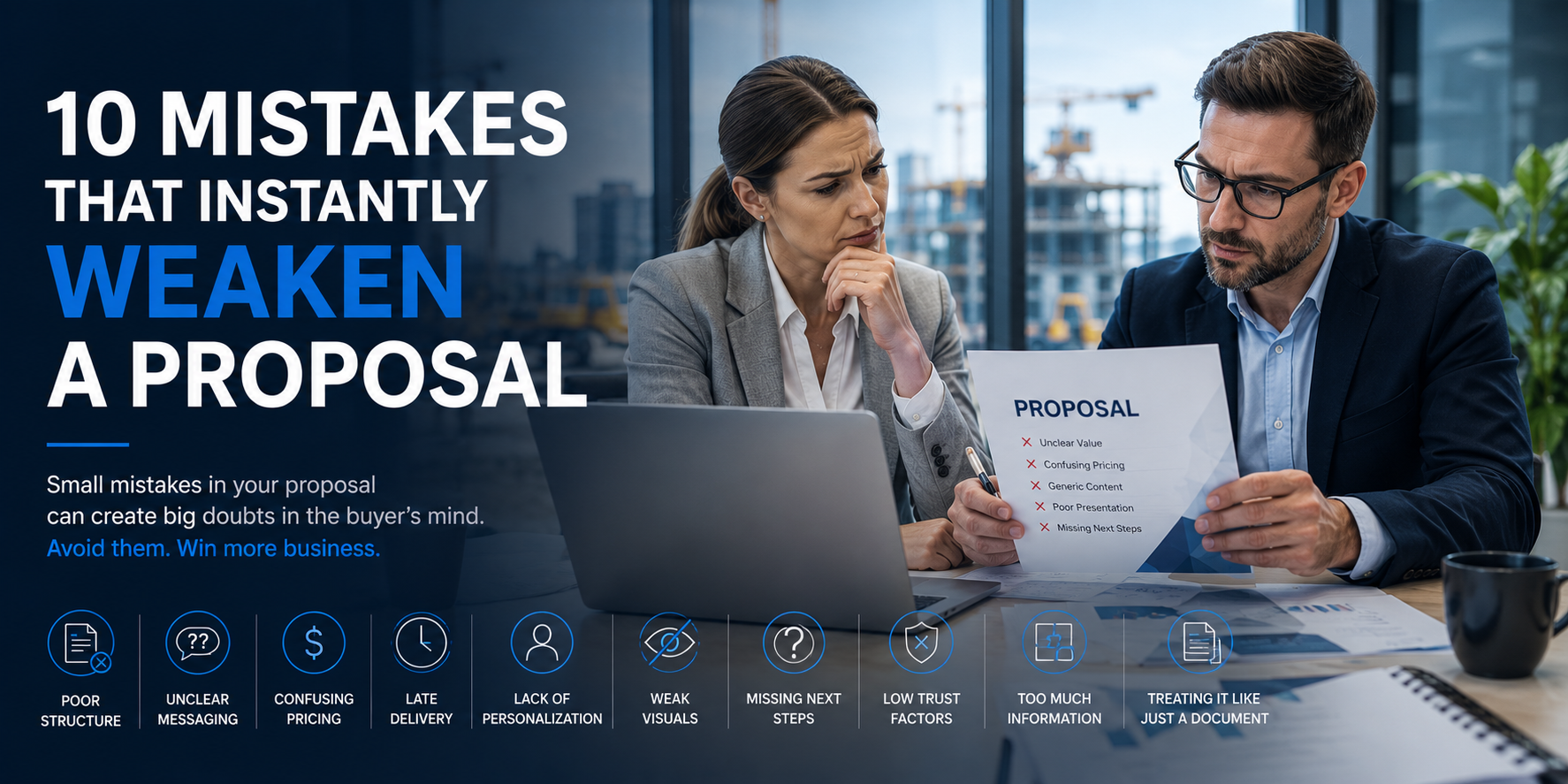
10 Mistakes That Instantly Weaken a Sales Proposal
Most businesses assume proposals fail because of pricing. In reality, many proposals lose momentum long before the customer properly evaluates the commercial offer itself.
Buyers form impressions quickly. The structure, clarity and overall experience of reviewing a proposal heavily influence how customers perceive your business, your professionalism and your ability to deliver successfully.
Even strong products and competitive pricing can struggle if the proposal creates friction, confusion or uncertainty. In many industries, proposals are not simply evaluated logically — they are judged emotionally.
Here are ten common mistakes that instantly weaken otherwise strong sales proposals.
1. Starting With Yourself Instead of the Customer
One of the most common mistakes is opening a proposal with several pages about your own company.
Customers usually care less about your office locations, company history or mission statement than businesses assume. What they really want to know first is whether you understand their situation and can solve their problem effectively.
Strong proposals quickly establish relevance by focusing on the customer’s goals, challenges and desired outcomes before discussing the supplier.
2. Overloading the Proposal With Information
Many businesses believe that more detail automatically creates more confidence. Often the opposite happens.
Large blocks of text, technical jargon and excessive detail create cognitive overload. Customers become mentally fatigued and start skimming instead of engaging properly with the proposal.
The best proposals simplify complexity. They make important information easy to understand without oversimplifying the solution itself.
3. Making Pricing Difficult to Understand
Pricing confusion creates hesitation almost immediately.
Customers become uncomfortable when proposals contain unclear line items, inconsistent pricing structures or unexplained costs. Even competitive pricing can feel risky if it is difficult to interpret quickly.
Businesses using interactive pricing and proposal workflows are increasingly improving customer confidence by presenting pricing in cleaner, more transparent formats that allow buyers to explore options more naturally.
4. Using Generic Proposal Templates
Customers can usually recognise generic proposals within the first few minutes.
If the proposal feels like a recycled template with only minor edits, buyers often assume the business has not invested much effort into understanding their specific needs.
Personalisation matters because it signals attention, care and commercial understanding. Customers want to feel that the proposal was created specifically for them, not mass-produced for every prospect.
5. Making the Proposal Look Outdated
Visual presentation strongly influences perceived professionalism.
A proposal that feels outdated, cluttered or poorly formatted can unintentionally lower perceived value before the customer has even reviewed the actual content properly.
Modern buyers are increasingly accustomed to polished digital experiences. Static documents with inconsistent formatting, poor visual hierarchy and low-quality presentation can make the entire business appear less organised.
6. Focusing Too Heavily on Features
Many proposals spend too much time describing features and not enough time explaining outcomes.
Customers are rarely buying functionality alone. They are buying efficiency, growth, risk reduction, simplicity, competitive advantage or operational improvement.
Strong proposals connect product capabilities directly to business impact. They explain what changes for the customer once the solution is implemented.
7. Creating Friction Around Decision-Making
The easier a proposal feels to navigate, the more likely customers are to move forward confidently.
Complex approval pathways, confusing option structures and unclear next steps create unnecessary decision fatigue.
Businesses using customer-facing proposal automation are increasingly simplifying this process with interactive approvals, configurable options and guided digital workflows that reduce friction throughout the buying journey.
8. Taking Too Long to Deliver the Proposal
Proposal timing affects buyer psychology more than many businesses realise.
Slow turnaround weakens emotional momentum after the original sales conversation. Customers may begin engaging with competitors or lose urgency around the project entirely.
Fast proposal delivery communicates responsiveness, operational capability and commercial interest. In competitive markets, speed alone can influence how professional and organised a supplier appears.
9. Failing to Build Trust Throughout the Proposal
Buyers are constantly evaluating risk throughout the sales process.
A proposal should gradually build reassurance by demonstrating understanding, structure, transparency and commercial confidence.
When proposals feel inconsistent or overly sales-driven, customers may begin questioning whether the implementation experience will feel equally difficult or unclear.
Proposal quality often becomes a reflection of perceived delivery quality.
10. Treating the Proposal Like a Document Instead of an Experience
Many businesses still approach proposals as static files rather than part of the overall buying experience.
Modern customers increasingly expect digital interactions that feel responsive, interactive and easy to navigate.
Businesses adopting modern digital proposal experiences are moving beyond traditional PDFs by creating proposals that support collaboration, dynamic pricing, approvals, eSignatures and customer interaction throughout the sales process.
The proposal is no longer just a summary of the deal. It is part of how customers evaluate the professionalism and capability of the business itself.
Final Thoughts
Most proposal weaknesses are not caused by the product or pricing itself. They are caused by friction inside the customer experience.
Customers are evaluating far more than technical capability. They are assessing clarity, responsiveness, trust, professionalism and how confident they feel about working with your business.
The strongest proposals reduce uncertainty, simplify decision-making and make the buying process feel commercially safe and easy to move forward with.
Businesses investing in digital sales proposal management are increasingly creating proposal experiences that feel less like static documents and more like guided commercial conversations.