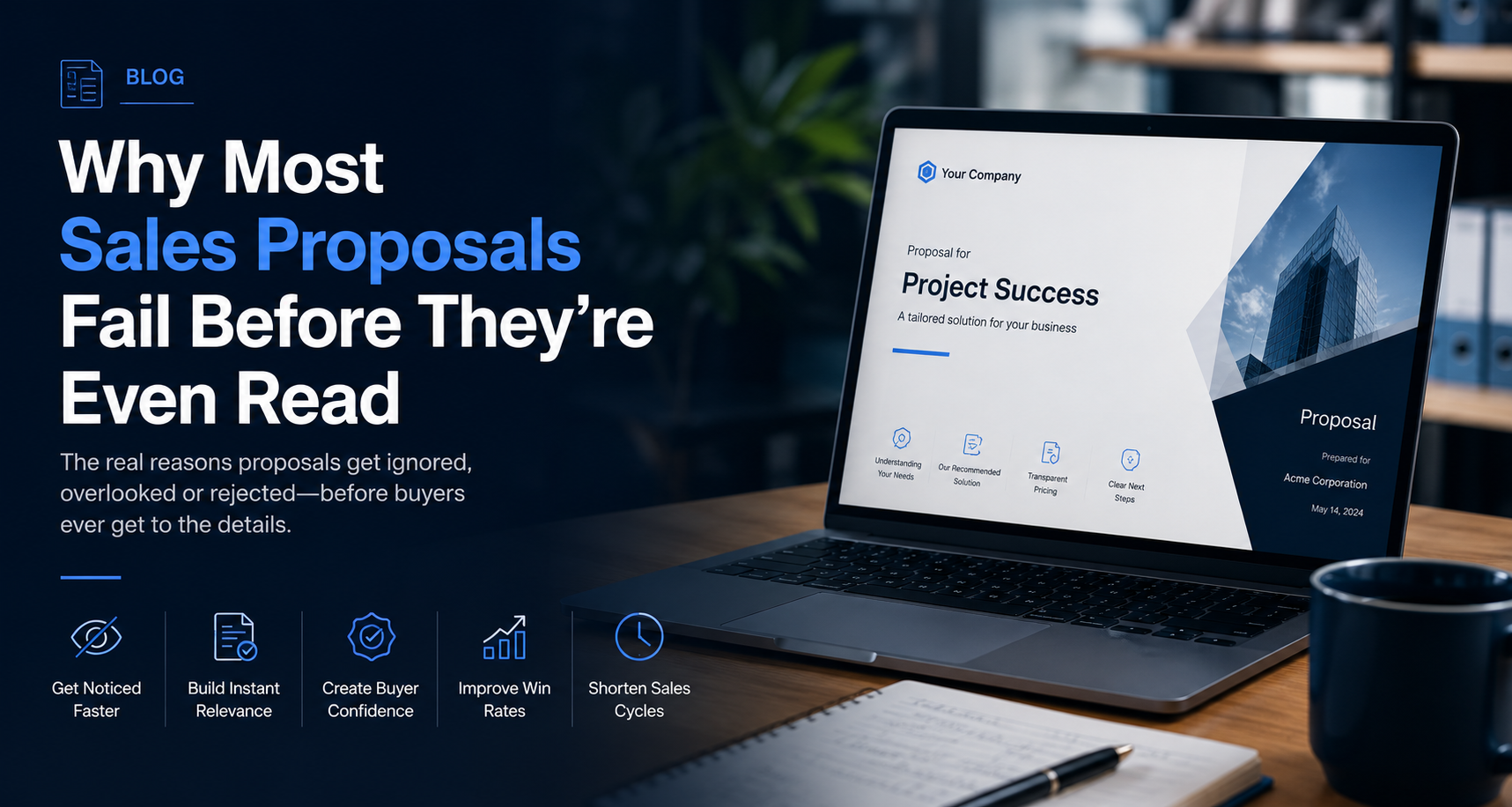
Why Most Sales Proposals Fail Before They’re Even Read
Most sales teams assume proposals fail because of pricing. In reality, many proposals fail long before the customer even evaluates the numbers.
The problem is often not the solution itself. It is the way the proposal is presented, structured and delivered.
Buyers today are overwhelmed with information. They are reviewing multiple vendors, juggling internal priorities and making decisions under time pressure. If a proposal feels difficult to read, generic, confusing or overly sales-driven, many customers mentally disengage almost immediately.
In many cases, proposals are not truly being “read” at all. They are being scanned, judged quickly and filtered emotionally within the first few moments of opening the document.
Most Proposals Feel Generic
One of the biggest reasons proposals fail is that they feel like templates rather than genuine responses to the customer’s situation.
Many businesses spend hours formatting documents but very little time making the proposal feel commercially relevant to the actual buyer. Customers can sense this quickly.
Generic introductions, broad capability statements and long company history sections often create distance instead of engagement. The customer is usually not asking: “Who are you?”
They are asking: “Do you understand our problem?”
Strong proposals create immediate relevance. Weak proposals create the feeling that the same document could have been sent to twenty other companies that day.
Customers Are Looking for Confidence, Not Just Information
Many proposals overload the reader with detail but fail to create confidence.
Buyers are not simply evaluating technical specifications or pricing tables. They are subconsciously assessing risk.
They want to feel confident that the supplier understands the project, can manage complexity, communicates clearly and will not create operational problems later.
When proposals are difficult to follow, overly technical or poorly structured, they unintentionally create uncertainty. Even if the actual solution is strong, the customer may begin questioning whether implementation will feel equally confusing.
Proposal quality often becomes a proxy for perceived operational quality.
Most Proposals Start in the Wrong Place
Many proposals begin by talking extensively about the seller. The company background appears first, followed by capability statements, office locations and pages describing the business itself.
The problem is that customers care about themselves first.
Strong proposals begin with the customer’s situation, challenges and desired outcomes. They show immediately that the seller has listened and understands the commercial context behind the project.
This changes the emotional tone of the proposal completely. Instead of feeling like a sales brochure, the document begins to feel like a relevant business recommendation.
Too Much Complexity Creates Friction
Businesses often assume that more detail makes a proposal feel more professional. In reality, excessive complexity usually reduces engagement.
Large blocks of text, inconsistent formatting, technical jargon and unclear pricing structures force customers to work harder than they want to. The moment reading starts to feel mentally exhausting, attention drops.
This is particularly common in technology, manufacturing and consulting industries where businesses deeply understand their own products but struggle to simplify communication for the customer.
The best proposals make complex ideas feel clear and manageable. That requires thoughtful structure, visual clarity and strong communication discipline.
Static PDFs Often Create Passive Buying Experiences
Traditional PDF proposals were designed for a very different era of selling. They are static, difficult to personalise dynamically and often disconnected from the broader sales process.
Modern buyers increasingly expect digital experiences that feel interactive, responsive and easy to navigate.
Businesses using interactive customer proposal workflows are moving beyond static documents by creating proposals that allow customers to engage more naturally with pricing, configurations, approvals and supporting information.
Instead of simply reading a document, customers can explore options, review solution pathways and move through approvals more seamlessly. This creates a more active buying experience rather than a passive document review process.
Many Proposals Focus Too Heavily on Features
Another common problem is that proposals often describe products and services extensively without translating them into business outcomes.
Customers rarely buy software, machinery or consulting purely because of features. They buy operational improvement, efficiency, risk reduction, revenue growth or competitive advantage.
A proposal that only lists capabilities forces the customer to mentally connect the dots themselves. Strong proposals do that thinking for them.
Instead of simply describing functionality, better proposals explain what changes operationally once the solution is implemented and why that matters commercially.
Poor Pricing Presentation Creates Distrust
Even when pricing is competitive, unclear pricing presentation can damage trust quickly.
Customers become uncomfortable when proposals contain inconsistent pricing structures, unexplained line items, hidden assumptions or layouts that feel difficult to follow.
Confusion creates hesitation. Hesitation slows approvals.
Modern digital sales document automation platforms allow businesses to structure pricing more clearly using interactive pricing tables, configurable options and cleaner commercial presentation.
When customers understand pricing quickly, decision-making becomes easier.
Speed Matters More Than Many Businesses Realise
Proposal quality matters, but timing matters as well.
Many businesses lose momentum simply because proposals take too long to produce. By the time the document finally arrives, the customer’s emotional engagement with the opportunity may already be fading.
Fast turnaround communicates responsiveness and operational competence. Slow turnaround often creates uncertainty, particularly in competitive sales situations.
Businesses that combine strong proposal structure with efficient document workflows usually create a significant competitive advantage.
The Best Proposals Reduce Decision Fatigue
Buyers today are making decisions in increasingly noisy environments. The best proposals simplify thinking rather than adding more cognitive load.
They guide the customer through the decision logically. They explain the problem clearly, present a practical solution, structure pricing transparently and make next steps feel easy.
Most importantly, they create confidence.
Customers rarely move forward because a proposal contains the most information. They move forward because the proposal makes the decision feel safer, clearer and commercially sensible.
Final Thoughts
Most sales proposals do not fail because the product is wrong or the pricing is too high. They fail because the proposal experience itself creates friction before the customer fully engages with the solution.
Generic messaging, confusing structure, static presentation and overly complex communication often cause buyers to disengage emotionally within the first few minutes of opening a proposal.
Businesses using modern proposal management workflows are increasingly focused on creating cleaner, more interactive and more customer-focused buying experiences that reduce friction and improve engagement throughout the sales process.