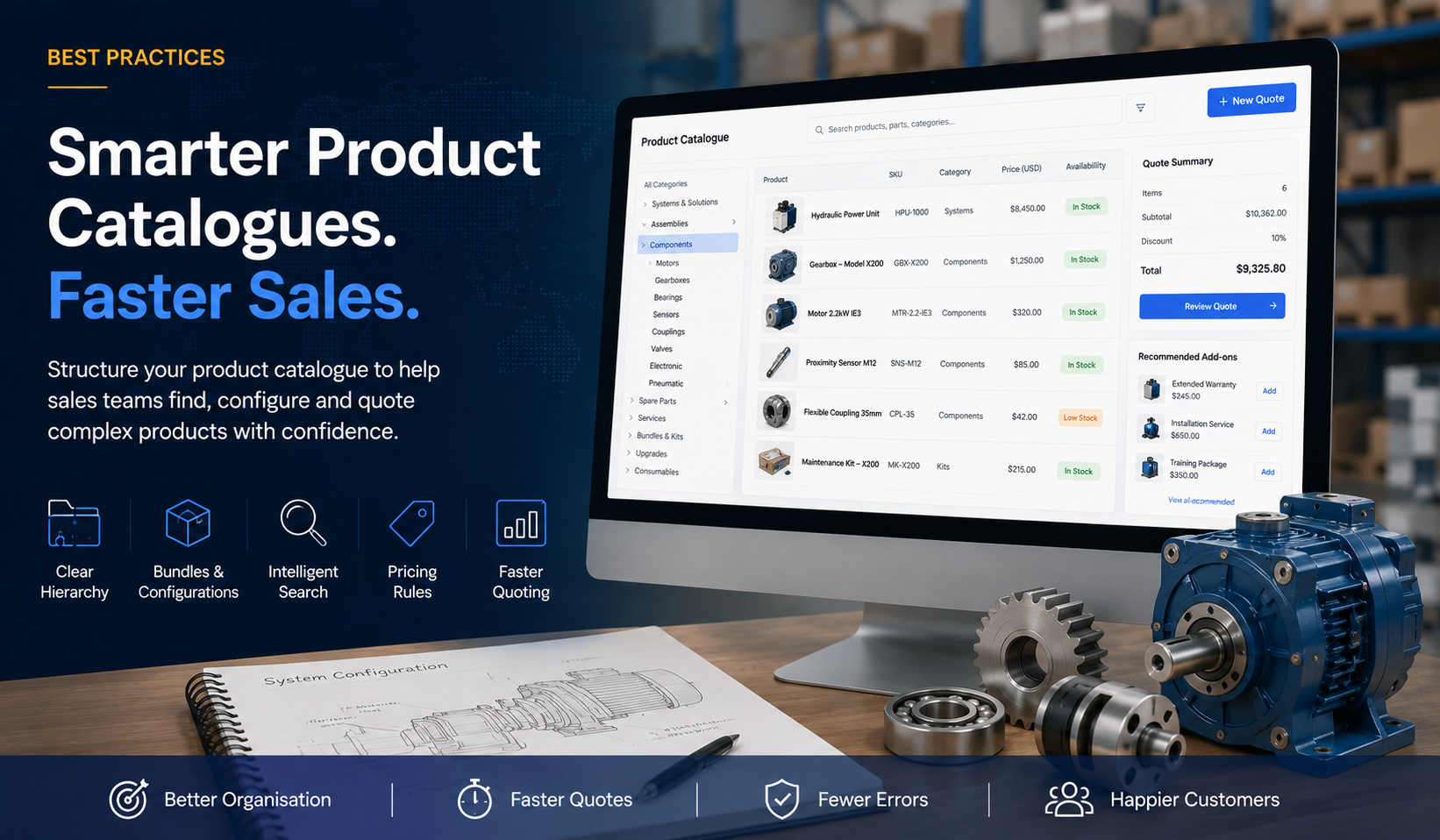
How to Structure Your Product Catalogue to Help Sales Teams Work Faster and Sell More Effectively
As product catalogues grow, they often become one of the biggest hidden bottlenecks inside a sales organisation. What may begin as a manageable list of products can eventually turn into thousands of parts, assemblies, consumables, service items and bundled solutions spread across multiple suppliers, departments and pricing models.
This is particularly common in manufacturing, wholesale distribution and industrial services businesses where products are highly configurable and customers rarely buy just a single standalone item. Instead, sales teams are often building complete solutions made up of interconnected products, optional upgrades, installation services and ongoing support arrangements.
When catalogue structure is poorly organised, sales staff spend too much time searching for products, relying on internal knowledge, checking compatibility manually or rebuilding common configurations from scratch. Over time, this slows down quoting, increases pricing inconsistencies and creates avoidable errors that directly affect the customer experience.
A well-structured product catalogue does much more than organise inventory. It becomes a practical sales enablement system that helps teams quote faster, configure solutions more accurately and present cleaner, more professional proposals to customers.
Most Product Catalogues Are Built Around Operations, Not Sales
One of the biggest structural problems businesses encounter is that product catalogues are often designed primarily around inventory control or ERP logic rather than the way sales conversations actually happen.
Operations teams naturally think in terms of stock codes, procurement categories, supplier relationships and warehousing structures. Sales teams think differently. They think in terms of customer outcomes, packaged solutions, applications and commercial use cases.
A customer rarely asks for twenty individual components by SKU number. They ask for a conveyor solution, a replacement assembly, a workshop fit-out, a production line upgrade or a complete machine package.
If the sales system forces staff to manually piece those solutions together every time, quoting becomes heavily dependent on experience and tribal knowledge rather than repeatable process. That creates problems as businesses scale because the catalogue becomes harder for new staff to understand and increasingly difficult to maintain consistently.
Good Catalogue Structure Reduces Cognitive Load
Large catalogues become much easier to work with when products follow clear and predictable hierarchy structures. The goal is not simply to categorise products correctly — it is to reduce the mental effort required for sales teams to find and configure products quickly under pressure.
In manufacturing businesses, this often means separating products into commercially logical groupings such as systems, assemblies, spare parts, consumables, installation services and maintenance programs. Within those areas, products can then be organised further by application, product family or industry use case.
The simpler and more intuitive the catalogue feels, the faster sales staff can move through the quoting process. This becomes increasingly important when teams are managing thousands of items across multiple brands or suppliers.
Businesses often underestimate how much quoting speed affects sales performance. Customers interpret slow quoting as operational inefficiency, especially in competitive B2B environments where response time can influence buying decisions.
Why Bundles and Configurable Solutions Matter
One of the most effective ways to simplify large product environments is through reusable bundles and pre-configured solution groups. Instead of forcing sales representatives to select every component individually, businesses can create standardised commercial packages that reflect how products are commonly sold in the real world.
A manufacturing business may have standard machine configurations, compliance packages, installation kits or maintenance programs that are repeatedly quoted together. Building these directly into the catalogue dramatically improves efficiency while reducing the likelihood of missing important components during the quoting process.
This approach also improves pricing consistency across the business. Rather than every sales representative creating their own interpretation of a solution, the organisation can guide staff towards approved structures, recommended configurations and commercially optimised bundles.
Modern sales quoting software allows businesses to combine configurable bundles with pricing logic, optional upgrades and automation workflows so proposals become both faster to create and easier for customers to understand.
Search Matters More Than Most Businesses Realise
In very large catalogues, search functionality often becomes just as important as the underlying category structure itself. Sales staff do not always remember exact SKU numbers or internal naming conventions, especially when products have evolved over many years.
Strong catalogue systems allow products to be found using partial keywords, customer terminology, supplier references, product attributes and common abbreviations. Intelligent search reduces friction dramatically and helps sales staff work far more naturally during customer conversations.
This becomes particularly valuable when dealing with complex replacement parts or highly technical assemblies where multiple products may appear visually similar but have important compatibility differences.
Good search functionality effectively reduces the dependency on memory and experience, which makes onboarding new sales staff much easier over time.
Catalogue Structure and Pricing Logic Should Not Be the Same Thing
Another common mistake is tightly coupling pricing rules directly into the product catalogue structure itself. In reality, pricing is usually far more dynamic than the underlying product relationships.
Pricing may vary based on customer agreements, regional taxes, tariffs, supplier changes, contract pricing, volume discounts or currency fluctuations. Trying to manage all of that complexity directly inside static product records often creates unnecessary administrative overhead.
Instead, the catalogue should focus on making products easy to understand and configure, while pricing engines and business rules manage the commercial logic behind the scenes.
This creates much greater long-term flexibility as the business grows or expands into new markets.
Reducing Reliance on Tribal Knowledge
Many industrial and manufacturing businesses unknowingly rely on a small number of highly experienced staff who simply “know” how products fit together. While that experience is valuable, it also creates operational risk.
When key staff leave, retire or move into different roles, businesses often discover that important product relationships and quoting logic were never properly documented inside their systems.
A well-structured catalogue reduces this dependency by embedding configuration logic directly into the quoting workflow itself. Compatible products, required accessories, recommended service items and upgrade paths can all be surfaced automatically during quote creation.
This not only improves consistency but also allows newer sales staff to become productive much faster because the system helps guide them through the configuration process.
The Customer Experience Also Improves
Product catalogue structure does not only affect internal efficiency. It directly influences how professional and understandable customer proposals feel.
Poorly organised product structures often lead to confusing quotes filled with inconsistent naming, duplicated items and unclear pricing relationships. Customers may struggle to understand what is included, which slows approvals and creates unnecessary back-and-forth communication.
Cleaner catalogue structures create cleaner proposals. Customers can understand the solution more easily because products are grouped logically and presented in a way that reflects the actual business outcome rather than internal stock management structures.
Businesses using interactive quoting platforms can also guide customers through optional upgrades, bundled solutions and configurable pricing pathways far more effectively than with static PDFs or spreadsheets.
Final Thoughts
Large product catalogues do not need to create sales complexity. In many cases, the real issue is not catalogue size itself, but how the catalogue has been structured around internal operational systems rather than practical sales workflows.
The businesses that manage complex catalogues most successfully are usually the ones that think carefully about how sales teams actually work in the real world. They simplify configuration, reduce unnecessary cognitive load, improve searchability and build reusable commercial structures directly into the quoting process.
Modern sales quote software allows businesses to combine intelligent catalogue structure, configurable bundles, automation and dynamic pricing into far more scalable sales workflows — particularly in manufacturing and industrial sectors where product complexity is high.