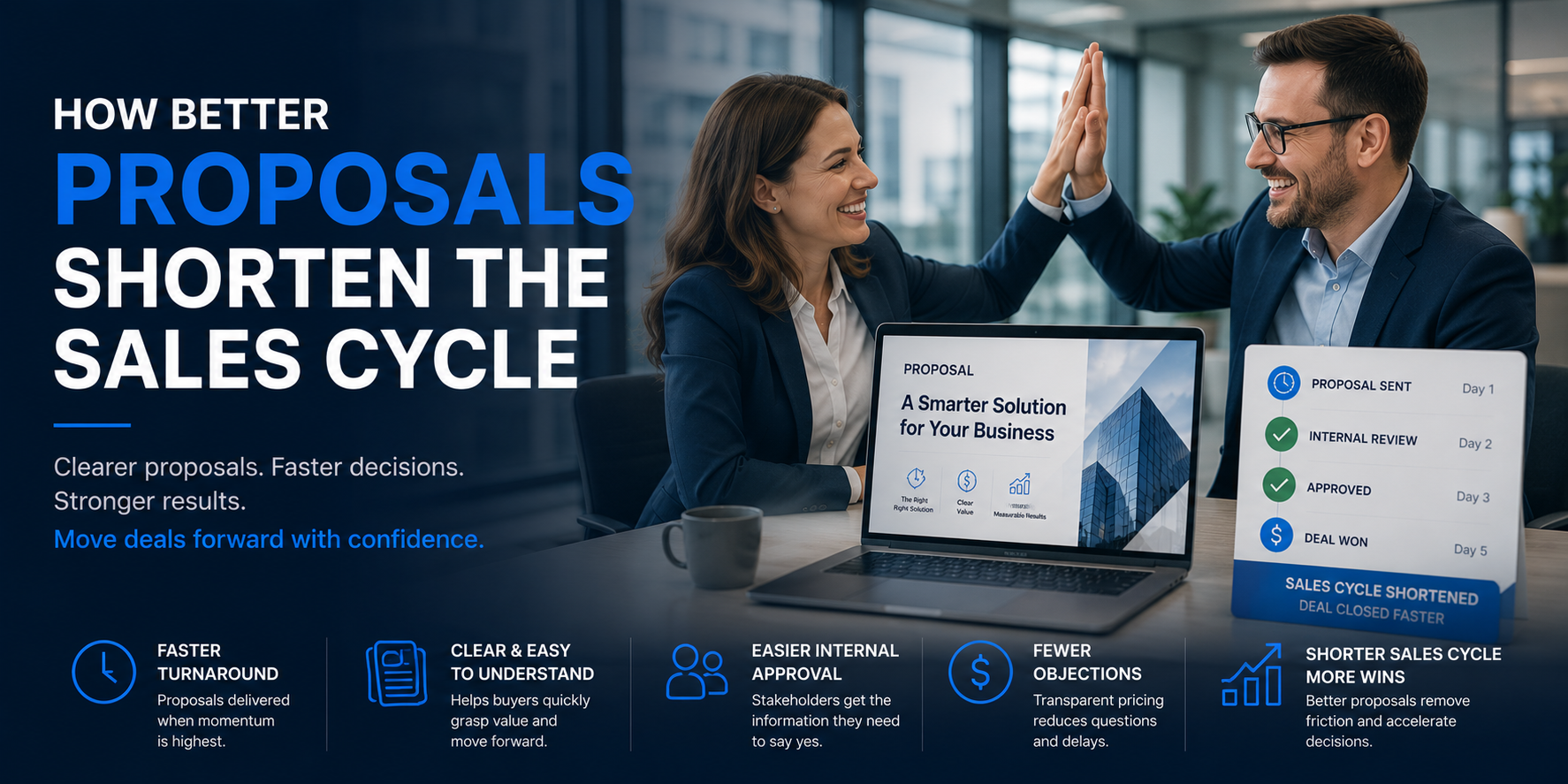
How Better Proposals Shorten the Sales Cycle
Many businesses focus heavily on lead generation and sales activity but underestimate how much the proposal itself influences sales velocity.
In reality, proposals often become one of the biggest bottlenecks in the buying process. Delays, confusion, unclear pricing and difficult approval workflows can quietly slow deals down even when customer interest is high.
Strong proposals do much more than present pricing. They help customers make decisions faster by reducing uncertainty, improving clarity and creating a smoother buying experience.
Businesses that improve proposal quality often discover they are not only winning more opportunities — they are closing deals significantly faster as well.
Most Sales Delays Happen After the Meeting
Many sales conversations end positively, only for momentum to disappear once the proposal stage begins.
The customer leaves the meeting engaged and interested, but then waits days for a proposal to arrive. When the document finally appears, it may feel overly complicated, difficult to review internally or unclear commercially.
Every delay creates friction. Every moment of uncertainty weakens buying momentum.
The longer customers spend trying to interpret pricing, clarify scope or explain the proposal to internal stakeholders, the more likely the sales cycle begins to slow down.
Clarity Speeds Up Decision-Making
One of the biggest reasons proposals delay sales cycles is simply because customers struggle to process the information quickly.
Many proposals contain:
inconsistent pricing structures, technical jargon, unclear scope boundaries and dense formatting that force customers to work harder than they want to.
Strong proposals simplify complexity. They make it easy for buyers to understand what is being recommended, why it matters and what happens next.
Customers make decisions faster when proposals feel clear, structured and commercially logical.
Customers Need to Sell Internally Too
In many B2B environments, the person receiving the proposal is not the only decision-maker involved.
The proposal often needs to move through multiple stakeholders including finance teams, procurement managers, operational leaders or executive approval processes.
If the proposal is difficult to explain internally, the sales cycle slows down immediately.
Strong proposals help the buyer advocate for the solution internally. They present information clearly, structure pricing transparently and reduce the amount of additional explanation required from the sales team.
In many cases, proposals that feel easier to present internally progress through approval processes much faster.
Fast Proposal Delivery Maintains Emotional Momentum
Timing matters far more than many businesses realise.
After a strong sales conversation, customer interest and emotional engagement are usually at their highest point. Delayed proposal delivery often weakens that momentum significantly.
Customers begin focusing on other priorities, competitor proposals or unrelated operational issues. The urgency around the project slowly fades.
Businesses using proposal automation and sales workflows are increasingly improving sales velocity by dramatically reducing proposal turnaround time while maintaining proposal quality and consistency.
Faster proposals often create the perception of stronger operational capability as well.
Better Pricing Presentation Reduces Objections
Poor pricing presentation creates hesitation even when pricing itself is competitive.
Customers become uncomfortable when pricing feels confusing, inconsistent or difficult to compare against business value. Unclear pricing often triggers additional questions, review meetings and procurement delays.
Well-structured pricing reduces friction by helping customers understand:
what is included, what options exist and how the investment aligns with the proposed outcome.
Businesses using interactive pricing and proposal management are increasingly allowing customers to explore configurable options, bundles and approvals more naturally instead of forcing buyers through rigid static documents.
Proposal Quality Influences Perceived Risk
Buyers are constantly evaluating risk throughout the sales process.
Proposal quality often becomes a reflection of how customers imagine the future working relationship will feel. If the proposal appears disorganised, difficult to follow or poorly presented, customers may begin questioning how smoothly implementation or delivery will operate later.
Strong proposals create confidence. They communicate structure, professionalism and operational maturity.
When customers feel confident in the supplier, decisions tend to happen faster because there is less emotional resistance throughout the buying process.
Interactive Proposals Reduce Buying Friction
Traditional PDF proposals were built for a much slower sales environment. Modern customers increasingly expect digital experiences that feel responsive and easy to engage with.
Interactive proposals allow buyers to:
review options dynamically, explore pricing pathways, approve digitally and collaborate internally more efficiently.
This reduces the back-and-forth communication that often delays sales progression.
Businesses adopting digital proposal collaboration tools are increasingly streamlining approvals, reducing revision cycles and improving overall buying efficiency.
Good Proposals Reduce Decision Fatigue
Buyers today are overloaded with information. Every unnecessary layer of complexity increases mental fatigue and slows decision-making.
The best proposals guide the customer naturally through the decision process instead of overwhelming them with excessive detail or unclear structures.
Good proposal design helps buyers focus on what matters most:
the business outcome, the recommended solution and the path forward.
When proposals feel easier to process mentally, customers are more likely to move confidently toward approval.
The Sales Proposal Is Part of the Product Experience
Many businesses still treat proposals as administrative documents rather than part of the customer experience itself.
In reality, the proposal is often one of the most important moments in the entire buying journey. It shapes how customers perceive the professionalism, responsiveness and operational quality of the supplier.
Businesses that invest in better proposal experiences frequently shorten sales cycles because customers encounter fewer obstacles between interest and approval.
Final Thoughts
Better proposals do far more than improve presentation. They actively reduce friction throughout the buying process.
Clearer structure, faster turnaround, transparent pricing and smoother approval workflows all help customers make decisions with greater confidence and less resistance.
Businesses using modern sales proposal workflows are increasingly shortening sales cycles by creating proposal experiences that feel easier, faster and more commercially reassuring for buyers.